
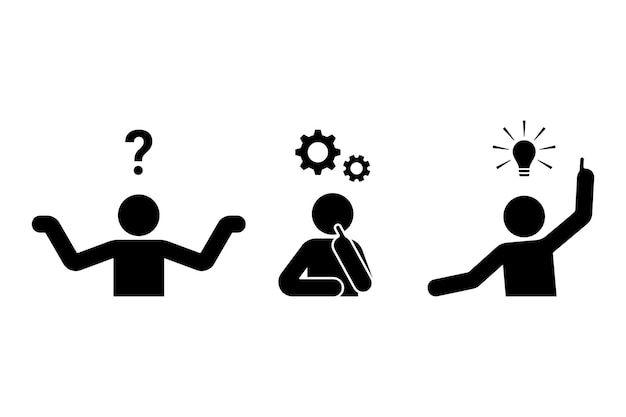
Theory
Even those people, who aspire to have a smooth sail through life, do not get the
best of the smoothness in their life. This is because, a lot of situations in our life
are beyond our control and often these situations throw a lot of challenges to us,
even if we are pro active. These challenges or problems in our life require a
resolution. The solutions to these problems roots from our thinking, to analyse, to
reflect, to look for choice and then decide on the best way forward. People, who
think, exercise their brain, gather various perspectives, create clarity and make
their way forward in life.
The common way of thinking means remembering, where we try and recollect
facts and concepts from our memory. The other way of thinking is related with
understanding, wherein one is able to recognize, identify, locate, specify and
explain aspects. The third way of thinking is referred to as applying wherein we
are able to make use of the concepts in better way in new situations.
Remembering, understanding and applying are considered to be known as lower
order thinking. Let us also go through the other forms of thinking.
Creative thinking- Also means thinking outside the box. It is when we make use of
the best of our imaginations to come up with new ideas and innovations. Creative
thinking begins when we step outside all established process, thoughts and rules.
Analytical thinking- This thinking involves a structured way of approaching tasks.
The whole task is divided into parts and each part is examined one by one to sort
out the problem.
Critical thinking- In this form of thinking, we set aside our personal beliefs,
presumptions and prejudices to discover truths and solve problems. Critical
thinking is a, well-disciplined thought process, which involves the use of skills like
conceptualization, interpretation, analysis, synthesis and evaluation for arriving at
a valid, solution.
Concrete thinking- It is thinking based out of what we can see, think, hear and
experience. It is practical thinking.
Abstract thinking – It refers to an ability to relate seemingly random things with
each other and make the connections to other items, events or situations.
Divergent thinking- It refers to our ability to create multiple ideas or solutions to
find the one that is effective.
Convergent thinking- It refers to our ability to solve a problem within the context
of known information and narrowing down the solution based on logical
inference.
Hence, to come out of our problems, we can utilize all these forms of thinking.
Have think times in our life to move forward.
Story
Rajiv was known in his office for one thing — speed.
He did everything fast — replying to mails, solving client issues, even finishing
lunch. His motto was simple: “Act first, think later.”
It worked most days — until the day it didn’t.
It was a busy Monday morning when the office printer decided to go on strike. A
big presentation was due, and everyone panicked. Rajiv jumped up, rolled his
sleeves, and said, “Relax, I’ll fix this!”
He pressed buttons, pulled levers, tapped the sides, and muttered a few technical
prayers. But the printer remained stubbornly silent.
Impatient, he unplugged it, shook it slightly, and plugged it back in — nothing.
Within minutes, there was chaos. Papers scattered, cables tangled, and the
printer beeped angrily, flashing a message that said: “Error. Ink system failure.”
Rajiv groaned. “Why does this always happen when I’m in charge?”
His colleague Maya, known for her calm and quiet ways, walked over holding her
cup of coffee. She looked at the messy battlefield and smiled. “Trying to fix it by
fighting it, Rajiv?”
He rolled his eyes. “Well, doing nothing isn’t going to print our presentation.”
Maya shrugged. “Maybe not. But sometimes thinking for two minutes saves ten
trying.”
Before he could reply, she bent down, checked the printer’s screen, read the error
message carefully, and simply opened the cartridge tray. She noticed that one of
the ink cartridges wasn’t locked properly. With one click, she fixed it.
The machine whirred, beeped twice, and started printing.
Rajiv blinked. “You did it?”
Maya smiled, sipping her coffee. “No, the printer did. I just listened before acting.”
The room burst into laughter, and Rajiv, slightly embarrassed, joined in. But
inside, he knew he’d learned something important that day.
Later, as he watched the printer spit out perfect pages, he thought, Maybe the
mind works like that too — when we stop reacting and start reflecting, clarity
flows.
From that day, Rajiv started what he called his “Think Time” — five minutes
before solving any major problem. He’d sit quietly, breathe, and write down what
he actually knew about the issue before jumping into action.
Weeks later, his boss noticed a difference.
“Rajiv, you’ve become calmer — and
somehow, more effective.”
Rajiv smiled. “Turns out, slowing down is the fastest way to get things done.”
Thinking time is not wasted time — it is wisdom time.
When we pause, we see. When we rush, we repeat.
Sometimes, the most powerful move is simply to stop, breathe, and think.
Activity
Out of think times you had, try and find out the forms of thinking you have
applied to find solution to your problem.
___________________________________________________________________
___________________________________________________________________
__________________________________________________________
Quote
“The world as we have created it is a process of our thinking. It cannot be changed
without changing our thinking.”
― Albert Einstein
Take Away
1. The solutions to the problems in our life roots from our thinking, to analyse, to
reflect, to look for choice and then decide on the best way forward.
2. Practice the forms of thinking to find solutions and remember to think “outside
the box “.