
Theory
People differ in how they interact with others, express themselves and recharge
their energy. Understanding these differences helps us improve communication,
relationships and teamwork.
Five commonly discussed personality labels are:
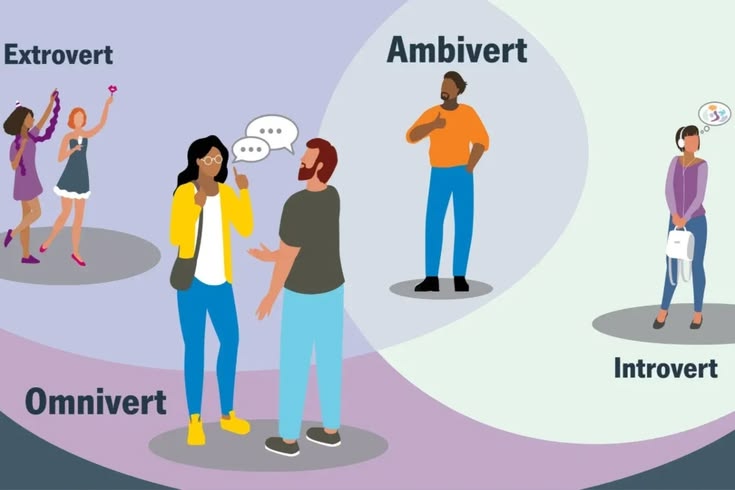
1. Introverts: Prefer solitude or small groups, enjoy deep conversations and
generally recharge through spending time alone. They often think before speaking.
2. Extroverts: Enjoy social interaction, group activities and meeting new people.
They often gain energy through interacting with others and expressing their
thoughts.
3. Ambiverts: Display a balance of introverted and extroverted characteristics.
They enjoy socialising but also appreciate personal space, depending on the
situation.
4. Omniverts: May shift noticeably between introverted and extroverted behaviour.
At times, they can be highly outgoing and expressive, while at other times they
prefer complete solitude.
5. Octoverts: This is an informal and less established personality label, without a
widely accepted psychological definition. It is sometimes used to describe people
who adapt across a wide range of social behaviours and interaction styles. It should
not be treated as a recognised personality category.
Remember: These labels are broad descriptions, not rigid boxes. A person’s
behaviour can change with circumstances, experience, confidence and
environment.
Story
Arun, Binu, Charan, Deepa and Eshan worked in the same organisation.
Arun preferred working independently and speaking only when necessary. Binu
loved networking, group discussions and social gatherings. Charan enjoyed both
teamwork and quiet working hours.
Deepa was extremely energetic and expressive during social events but preferred
complete silence and solitude afterwards. Eshan adapted his communication style
to different people and situations.
Their manager initially wondered why they behaved so differently. Over time, he
realized that each person had a different way of interacting and contributing.
Instead of expecting everyone to behave alike, he assigned responsibilities by
considering their individual strengths. The team became more productive,
collaborative and harmonious.
Learning
There is no single ideal personality type. Introverts may excel in focused work,
extroverts in networking, ambiverts in balancing both, and omniverts in adapting
between contrasting social preferences.
The key is to understand ourselves and respect the differences in others. Effective
communication begins when we adapt our approach rather than expecting
everyone to think and behave like us.
Activity
Identify which personality description most closely reflects you.
1. Do you prefer solitude, social interaction or a balance of both?
2. Does your behaviour change significantly depending on the situation?
3. How can you adapt your communication style to work better with people
who are different from you?
Quote
“Everyone shines, given the right lighting.” – Susan Cain
Take Away
1. Understand your personality, but never allow a label to limit your potential.
2. Respect different personality styles and avoid judging people based on their
social behaviour.
3. Adapt your communication to the person and situation.
4. Diversity in personality, when understood and respected, can become a
powerful strength in teams and relationships.