
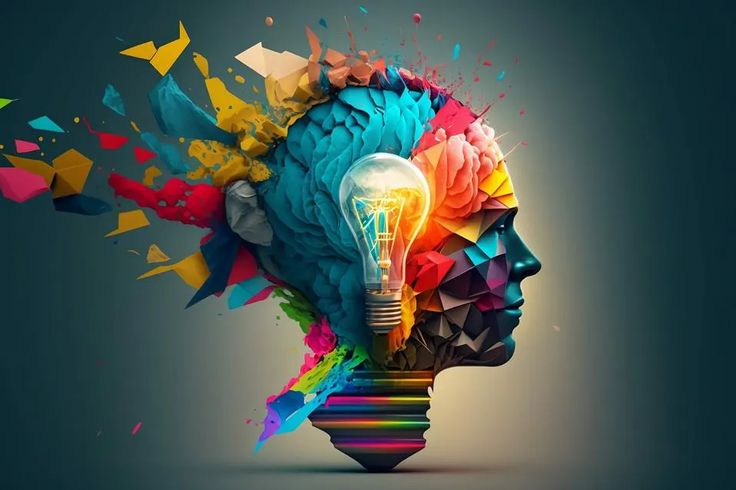
Theory
In simple way, creativity means the ability to come up with new ideas. Innovation
is about utilising these created new ideas and developing them into something
useful and practical. Hence, creativity and innovation go hand in hand.
Remember, innovation never happens without creative people. When we think
different, we come up with something different.
Creativity is about creation. It is the capability or the act of conceiving something
original or unusual. It is about harnessing the power of the mind to come up with
new ideas, plans and strategies. Creativity could be a way of expression or it could
be a way of problem solving. Creativity is about thinking outside the box, and
coming up with something new and original.
Innovation is the implementation of something new that will realize value to
others. Innovation is the act of putting things into practical reality, despite
challenges and resistance. Innovation also brings in differences or improvements
which may be in the form of new and improved products and processes. Products
driven by innovation may disrupt the market and come up with huge value for
customers.
Story
In a small town in Japan, the grocery shop owners had a peculiar problem.
Their stores were small — tiny compared to the sprawling supermarkets in
America — and space was precious.
But the problem wasn’t with the stores. It was with the watermelons.
Big, round, bulky watermelons that refused to fit neatly on shelves. Every time
the shopkeepers tried to stack them, they rolled away like stubborn little planets.
One frustrated shopkeeper finally sighed, “If only these watermelons were
square! Then we could store them easily.”
Everyone laughed. “Square watermelons? That’s like asking for a round box or a
straight rainbow!”
Except one farmer — Hiroshi — didn’t laugh.
He simply tilted his head and said, “Hmm, Why not?”
That night, while others went to bed with the same old problem, Hiroshi went to
bed with a new question:
“What if the problem isn’t the watermelon… but the way we think about it?”
The next day, Hiroshi began experimenting. He took a wooden box — square,
sturdy, and transparent — and placed a young watermelon inside it. As the fruit
grew, it pressed against the edges of the box.
Weeks passed, and to everyone’s surprise — the watermelon took the shape of
the box. Perfectly square.
When he brought it to the market, the shopkeepers couldn’t believe their eyes. It
fit beautifully on the shelf — no rolling, no wasted space.
Customers loved it too — easy to store, easy to cut, and yes, delightful to show off.
Soon, other farmers followed.
What began as an impossible idea became a shining example of Japanese
ingenuity.
When asked how he came up with the idea, Hiroshi smiled and said,
“Most people try to change the world around the watermelon. I just changed the box.”
True creativity isn’t about finding new things — it’s about seeing old things in new ways.
While most people complain, the creative mind questions.
While most see limits, the innovative mind redesigns them.
Innovation begins the moment we stop saying “It can’t be done”
and start asking “How can it be done?”
Activity
Give a brief about how you utilized your creativity and innovation to come out a
real life problem.
___________________________________________________________________
___________________________________________________________________
___________________________________________________________________
_______________________________________________________
Quote
“The true sign of intelligence is not knowledge but imagination.”
—–Albert Einstein
Takeaways
1. Creativity involves breaking out of established patterns in order to look at
things in a different way
2. Changes call for innovation, and innovation leads to progress.